Monday, 27 May 2013

Friday, 24 May 2013
Martial Arts Training for Real Self-Defense: Making Sense of Chaos
I once had a talk with a student who
pointed out the almost insane notion that anyone could think that they could
use a preset string of moves (known as a kata, pronounced kah-tah) to handle
something as chaotic as a fight. He said it made no sense to him how any
master, who really knew what he was talking about, could pass down "the
answer" to such an unknown as a fight.
He's right. And yet, day after day,
in countless schools, training centers, police departments, and military units
around the world, there are those who believe that what they are learning will
be exactly what they need to win, should they ever be attacked.
Can you imagine, for those of you
who have yet to be accosted, what it feels like inside the heart of an attack?
I mean, what do you know about the situation that you haven't been in yet?
Unless you're clairvoyant and can
see into the future - in which case you wouldn't need self-defense training
because you would either...
1) know what to avoid, or...
2) know you weren't going to survive
-
There is a plethora of things that
you don't, and can't possibly, know about this situation that hasn't happened
yet. Things like:
A) Where you will be attacked
(parking lot, building, your car, at-home in-bed, etc.)
B) Who your attacker will be
C) How many assailant's you will
face
D) Whether or not there are any
weapons involved (and what type, if any)
E) How you will be attacked
F) What you'll be wearing or
carrying that could help or hinder you, and...
G) Much, much more!
So, how can anyone think that a
preset string of moves will be of any use to them in an actual, real-world,
attack? Better still, why would they have been passed down for hundreds of
years if they couldn't help?
Well, the short of it, based on my
own research, is this. There are two schools of thought when it comes to
answering this question. The first is the idea that says...
..."we must make sure that
warriors have a way to practice during periods of peace so that they'll be
ready for the next war. So, what we'll do is string some basics together in a
way that they can rely on repetitive practice to stay ready."
The other so-called
"school-of-thought" said, "Let's look at the most common attacks
that we, with our current set of circumstances, will have to deal with. Then,
we'll design a set of example techniques - "fight-scenarios if-you-will -
that contain the essence or idea of what could be done in a situation like
that. We'll convey the principles and concepts through techniques that are not
so-much "set-in-stone" as they are representations of these
principles in action."
One school recognized the need to
practice the basic mechanics - the "brand" of punching, kicking, etc.
(the "secrets") - of their art when there wasn't a war going on. In
fact, most schools of training in Japan are still passed on this way. The
school allows the student's own intuitive and perceptual powers to determine
his or her own level of understanding.
However, for many of these martial
systems, the techniques ARE the art. That means that they represent that which
makes a particular lineage's techniques and "style" unique among all
others. It is not generally acceptable to change the techniques for any reason,
as in the case of my friend that I talked about earlier.
The other school recognized that
there is an infinite number of combinations if we were to just focus on the
mechanics alone. They also recognized that "what" you do is not
nearly as important as "when", "why," "how," and
under what circumstances you would do anything. Granted, this was more difficult
to understand than the basic step-by-step method (which this school DID employ
by-the-way), but the idea was that, the principles were much more important
than the techniques if one were to win in a conflict.
While the step-by-step, preset model
approach does teach students how to apply techniques, from my perspective and
experience with having to deal with violent attackers in real-world
self-defense situations, it is the later approach - the focus on workable
principles and concepts for controlling the situation - that provides the real
keys to mastery.
But, it's not martial arts mastery -
the mastery of technique - that I'm talking about. But rather the ability to
master and control...
Your Environment
Your Attacker's Perceptions
The Space and Distance within the
fight
The Assailant's Options
And much Much MORE!
...that allows you to control the
very flow of the situation, from moment-to-moment, as it unfolds.
It is this grander-view of the
reality of the situation that allows the true martial arts master - the
strategic warrior commander, to see beyond the mere punching, kicking, or
slashing of the attacker. It is the view that allows us to make sense out of
the chaos that is a fight and...
...appear to be magicians and
wizards to others with less understanding of the workings of nature and the
enlightened wisdom of the trained martial master.
by Jeffrey Miller
Original article:
http://goarticles.com/article/Martial-Arts-Training-for-Real-Self-Defense-Making-Sense-of-Chaos/174409/
Tuesday, 21 May 2013
Friday, 17 May 2013
Defeating The Headlock
Part I - At The Moment Of Initiation

As kids we used headlocks when rolling around the living room with our sibling, or when play wrestling with our dad or friends.
A headlock can be playful, or can be used to control another person, and/or wrestle them to the ground. In this way, it is not in itself dangerous. But, the headlock can also be used to hold someone in position while punching him in the face, or used to squeeze the neck to cause pain or unconsciousness. This is often what happens in a fight.
If you are on the street or in a bar and you are put into a headlock standing, or pulled to the ground in one, you become an easy target for their kicks and punches from the assailant's friends.
So what do you do? Almost every self-defense course teaches you techniques to use against a headlock, but many techniques do not work, or are not applicable to all situations.
In this and the following article we will illustrate two techniques (with a few variations) that are effective against the headlock and teach when to use them.
First, it should be said, you can react differently at different stages of a headlock, and you can also progressively escalate your response. Your response should also match the situation. Responding against a dangerous attack on the street is one thing; getting out of a headlock from a playful friend is another. Also, you should be sure that what you depend upon will work, if needed.
Responding To The Initiation Of A Headlock
Before someone gets a secure headlock on you, there is time to react. First, the attacker's arm comes around your neck. Then the hand or wrist is grabbed by the attacker's other hand, and the arms begin to tighten as the shoulder dips. You can take advantage of this movement as shown below.
 |
 |
 |
If you are an aikidoka (one who practices aikido) this technique will seem familiar. This response is practiced in my aikido organization Wadokai Aikido founded by Roy Suenaka Sensei. Similar techniques are also taught in many jujutsu and grappling arts.
Here the attacker has brought an arm around your head and pulls in and down. Go with the motion. As you do, and before the attacker's arms are securely closed, shove the fingers of both your hands (palm down) between your own neck and his arm and wrap them around the attacker's left forearm.
As your head moves down (going with the motion), roll the attacker's forearm outward as you also pull it down and away from your neck (using your own weight and not just arm strength). This will create a little space for your head to slip free.
As you do this, circle the top of your head toward the attacker's ribs, with your body circling away too -- only a slight change in the direction the attacker was pulling you. You will find yourself outside the grip, to the side of the attacker and with the attacker's forearm in your control.
 |
 |
You are trying to bend the opponent's arm up along his back (often called a "Chicken Wing"). To do so you should circle around behind the opponent. If you stay at the opponent's side, his arm is difficult to bend at the elbow and you will find yourself in a muscle against muscle situation. But if you move behind, the opponent's elbow will easily bend making the technique effective.
From here you can easily spin the opponent to the ground (not shown). Or, as shown here, your left arm is used against the opponent's head, pushing the face to the right (in a combat situation the flat of the hand is first used as a strike) -- a very uncomfortable position and one which allows you have assume control over him. In another variation, the left hand grabs under the opponent's neck to secure the collar of his uniform (gi) and then pulls toward you to effect a choke (not shown).
By Christopher Caile
Original article source: http://www.fightingarts.com/reading/article.php?id=203
Thursday, 16 May 2013
Developing Sixth Sense Ability In Kung Fu
Sixth Sense Ability, in martial arts like Karate, Taekwondo, Kung Fu, or whatever else, seem to have become not much more than rumors from the past. People learn how to fight like demons, but they don't learn how to perceive the world without the use of the five physical senses.
That's the truth of the matter, you know, sixth sense ability includes all the things that don't depend on see, hear, smell, and so on.
Simply, if it is a physical sensation, it is not a sixth sense perception. In martial arts like taekwondo and kenpo and so on, it is being able to 'feel' when an attack is coming before it is even launched. It is knowing what an attacker is going to do before he even tries it.
The best method for gaining sixth sense abilities is to learn how to practice without the use of the five physical senses. For instance, the surest technique is simply to do your moves without the use of the eyes. Simply close your eyes, or blindfold yourself, and do your kata, and get somebody who is willing to risk a few light punches, and do your martial arts techniques.
The thing here is to realize that you are not trying to hear or smell, or something like that, but to 'know.' Here's a question for you: have you ever walked up to a door and placed the key right into the keyhole while your focus is on a conversation, or seeing what somebody is doing? Most people have, and that is the easiest example of 'knowing' that I can give you; you knew where the lock was.
So try practicing without using the five physical senses. Do sticky hands, out of Wing Chun, without the use of the eyes, and learn to 'know' what your opponent is going to do. Or, how about blindfolding yourself and practicing push hands from Tai Chi Chuan, or some other similar drill.
My favorite device is to set up a small ring, and thrust a six foot (or longer) pole through it. Once I've got it centered, I close my eyes. And, once I can do that pretty easy, I take a few steps through the room, return to my starting position and thrust the pole through the ring.
The thing that you should understand is that the sixth sense depends on imagination. If you close your eyes and imagine where the hanging ring is, then you can thrust a pole through it. Or a spear or a sword or even throw a shuriken through it.
So the sequence is this: train with forms and precise martial arts applications so that you build a structure, a frame of reference, a scientific way of dealing with the world. Second, practice closing your eyes figure out how to train without having to use your physical senses. Third, in this matter of gaining sixth sense abilities in kung fu and other such martial arts, is to use your imagination; that is your true power, you know: imagination.
By Al Case,
Article source: http://www.articlesbase.com/martial-arts-articles/developing-sixth-sense-ability-in-kung-fu-6413551.html
Friday, 10 May 2013
Zenkutsu-Dachi - Understanding and Use of this stance
Zenkutsu-dachi is primarily known in Shotokan Karate as the Front Stance, and can also known as:

Forward movement in our system (Shotokan Karate) is very important. Stepping forward swiftly with an oi-zuki (lunge punch) intent on ending the confrontation with a single decisive blow, is common technique for the Shotokan practitioner.
Understanding and mastering zenkutsu-dachi helps with better understanding of all other stances, thus being the very first stance we are taught in class. Zenkutsu-dachi is also one of the easy stances to learn and is taught first through the Hein kata.
Being in correct stance creates the perfect angle that puts us at an
advantage for that single decisive blow as mentioned above, but also
puts our opponent at a disadvantage.
This final single blow needs the forward direction of energy that comes from a strong zenkutsu-dachi. Learning the fine points of zenkutsu-dachi is vital in mastering punching technique and power transfers, blocking, weight distribution, body centring, upper and lower body connections and also ground connections.
Foot positioning and weight distribution is important for directing power forward by stepping. Transferring weight in this technique is just one part of the equation.
Breathing is also key and needs to be kept low in the diaphragm so as not to raise the centre of gravity by breathing too shallow or high. How we make use of the centre of gravity in the stance determines the control we have over our own movements and that of our opponent’s.
By having the heels firmly planted on the ground, we create a solid connection between the ground and our opponent. Moving forward while punching may not suffer from a raised heel but connecting a block to the ground, having a solid foundation while static or moving back may require the planted heel for counter action. Let’s say we have a left block against a right attack, the right leg would shoot back with the heel planted firmly on the ground.
We should rather drop into stance rather than just merely stepping backward. Stepping too much and sending the centre of gravity back takes away from the forward projection of the stance. Planting of the back heel should be timed with the blocking arm making contact with our opponent to add support. The punch is next and feeling the solid contact with a target and reaction of the back leg / heel into the ground along with the power of the back leg thrust brings it all together.
The upper/lower body connection goes hand in hand with connection to the ground. The upper body must work together with the lower to create the right sequence of events to maximize our efficiency. The step is made, the feet planted, the hip goes and then the block.
If the upper and lower body are working together, the initial step will be smaller and the landing and hip action will be working together with the arms to power them into the block. We stepped into front stance with an upper level block and at this point we cock our hips. The hips are cocked in preparation for the counter attack.
This is also a spring load for a natural catapulting of a counter attack when used correctly. Important here is combining hip torque with moving the centre forward to project into the opponent rather than just the hip alone.
Zenkutsu-Dachi Stance
By: KK. See the original article here: http://www.intermartialarts.com/article/zenkutsu-dachi
- Forward Stance.
- Forward Leaning Stance.
- One foot in front and one foot at the back.
- The front foot should be pointed forward.
- The back foot should be pointing forward at an angle of ± 22.5°
- 70% of the body weight should be on the front foot and the other 30% on the back foot
- The front leg will be bent forward and short in a 90° angle.
- The back leg will be stretched out long and straight.
- Both feet should be planted firmly on the ground.
- The hips will be closed (to the side) when blocking.
- The hips will be open (to the front) when striking/punching.
Forward movement in our system (Shotokan Karate) is very important. Stepping forward swiftly with an oi-zuki (lunge punch) intent on ending the confrontation with a single decisive blow, is common technique for the Shotokan practitioner.
Understanding and mastering zenkutsu-dachi helps with better understanding of all other stances, thus being the very first stance we are taught in class. Zenkutsu-dachi is also one of the easy stances to learn and is taught first through the Hein kata.
This final single blow needs the forward direction of energy that comes from a strong zenkutsu-dachi. Learning the fine points of zenkutsu-dachi is vital in mastering punching technique and power transfers, blocking, weight distribution, body centring, upper and lower body connections and also ground connections.
Foot positioning and weight distribution is important for directing power forward by stepping. Transferring weight in this technique is just one part of the equation.
Breathing is also key and needs to be kept low in the diaphragm so as not to raise the centre of gravity by breathing too shallow or high. How we make use of the centre of gravity in the stance determines the control we have over our own movements and that of our opponent’s.
By having the heels firmly planted on the ground, we create a solid connection between the ground and our opponent. Moving forward while punching may not suffer from a raised heel but connecting a block to the ground, having a solid foundation while static or moving back may require the planted heel for counter action. Let’s say we have a left block against a right attack, the right leg would shoot back with the heel planted firmly on the ground.
We should rather drop into stance rather than just merely stepping backward. Stepping too much and sending the centre of gravity back takes away from the forward projection of the stance. Planting of the back heel should be timed with the blocking arm making contact with our opponent to add support. The punch is next and feeling the solid contact with a target and reaction of the back leg / heel into the ground along with the power of the back leg thrust brings it all together.
The upper/lower body connection goes hand in hand with connection to the ground. The upper body must work together with the lower to create the right sequence of events to maximize our efficiency. The step is made, the feet planted, the hip goes and then the block.
If the upper and lower body are working together, the initial step will be smaller and the landing and hip action will be working together with the arms to power them into the block. We stepped into front stance with an upper level block and at this point we cock our hips. The hips are cocked in preparation for the counter attack.
This is also a spring load for a natural catapulting of a counter attack when used correctly. Important here is combining hip torque with moving the centre forward to project into the opponent rather than just the hip alone.
Zenkutsu-Dachi Stance
- We step forward swiftly with a powerful oi-zuki
- We have the bonus mass behind us and we are moving our whole body forward into our opponent
- The support leg is driving into the ground as it drives all our mass forward into our opponent
- We are breathing through our lower abdomen, keeping the centre of gravity low and not raising the breathing into the chest
- We are moving our centre forward and not lunging chest first
- Proper timing of technique with opponent as well as keeping the back heel on the floor
- We should use the hips correctly depending on block or strike / punch
By: KK. See the original article here: http://www.intermartialarts.com/article/zenkutsu-dachi
Thursday, 9 May 2013
Up Against The Wall
by Christopher Caile
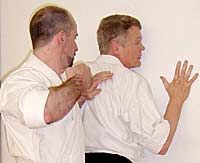 It's not an enviable position - to be pushed from the back into a wall,
or up against a car or other object. Shocked by the suddenness of the
attack, and back turned to the assailant, most people are totally defenseless.
It's not an enviable position - to be pushed from the back into a wall,
or up against a car or other object. Shocked by the suddenness of the
attack, and back turned to the assailant, most people are totally defenseless.In bars I've seen people pushed forward into tables and posts, or against the bar, and then struck down from behind. But the backward push is also commonly used in robberies -- pushing a woman, for example, against her car in order to rip away her handbag.
This was working so well in Buffalo a few years back that I was part of a team that was asked to give several self-defense seminars to federal and state employees. (1)
Escaping a push isn't really that difficult if you practice some simple basics. First thing to remember is not to get "squished," that is, not to let yourself get pushed totally flat into something (as seen in the photo above).
 |
 |
 |
Allow your arms to absorb some of the energy that is propelling you forward. This also keeps the body some distance away from the wall or other object so there is some room to maneuver. Then relax the left arm, allowing the left side to pivot inward (still keeping my right hand against the wall to maintain some distance) toward the wall around the right leg. As your left shoulder passes the wall, lower your right arm and move it with your body. The arm in this way will knock the assailant's pushing arm to the inside.
The key here is not to resist the attack, but to move with it, pivoting to let the assailant's own energy propel him into the wall, while you have turned outward to his outside. Your right hand ends up at about his groin level. From this position many things are possible.
| One choice is just to flee. But there are many other options. You could simply punch to the side of the head (not shown). If you just want to control the attacker, you can activate an arm bar and take him or her down. As in the photo above, you might add a left palm heel strike to the back of the attacker's skull to stun him or her first (this same technique is also used below). You may also use your turning movement to do a left elbow strike to the same target (not shown). |  |
 Another option also stems from the same left palm heel strike to the back of the attacker's skull. In this move you do not rotate your body quite as far, so you can move your right hand in front of your opponent to slap or hit upward into the groin.  Then
grab the pants near the groin (or reach deeply between the legs
to grab the belt from the back). Then you can lift with your right
arm and push with your left forearm against the front of the opponent's
head -- propelling him or her backward to the ground. This type
of throw usually results in the attacker landing on his side. Then
grab the pants near the groin (or reach deeply between the legs
to grab the belt from the back). Then you can lift with your right
arm and push with your left forearm against the front of the opponent's
head -- propelling him or her backward to the ground. This type
of throw usually results in the attacker landing on his side. |
 Just
the dump into the ground can stun most attackers (especially if there
is head contact, so be very careful if you practice this move), but
if you desire you may also apply a finishing strike to the side of the
attacker's head or jaw. Use your right bent knee against the opponent's
hips to keep him or her from turning towards you. Your left arm can
also hold the opponent's arm so his or her elbow is locked against your
left leg momentarily to help lock your opponent in place.
Just
the dump into the ground can stun most attackers (especially if there
is head contact, so be very careful if you practice this move), but
if you desire you may also apply a finishing strike to the side of the
attacker's head or jaw. Use your right bent knee against the opponent's
hips to keep him or her from turning towards you. Your left arm can
also hold the opponent's arm so his or her elbow is locked against your
left leg momentarily to help lock your opponent in place.There is also a happy ending to this article. Remember, we taught this simple turn and escape (and other self-defense techniques) to federal and state employees in Buffalo. Not long afterward we were informed of the results. In the month preceding our seminar five female employees had been assaulted and robbed outside the Federal Building by assailants who had first pushed their victims against their cars in order to tear away their purses. In the month afterwards, we were told, there were four similar attacks, but none were successful. I think it goes without saying that we were invited back for more seminars.
Footnote:
(1) The Seminar team included an aikido teacher Mike Hawley, a judo teacher and fellow aikido-ka, Eric Joseph and myself as a karate teacher and aikido-ka. We taught technique. A volunteer Buffalo police lieutenant also lectured on awareness and how to avoid getting attacked. As a group we taught similar seminars to many corporations and groups in Buffalo and the greater Erie County. In the seminars this technique was taught by Hawley Sensei (Wadokai Aikido) and it comes from aikido. The technique was so impressive and effective that I incorporated it into my own vocabulary of self-defense.
You can see the original article here: http://www.fightingarts.com/reading/article.php?id=198
Wednesday, 8 May 2013

Tuesday, 7 May 2013
Benefits of the Martial Arts Training
The ultimate goal in the martial arts does not lie in victory, but in
the perfection of the character of its participants. The perfection of
one's character is at the core.
Many people seek martial arts training with violence in mind. Some people are afraid and wish to learn to defend themselves, others are angry and wish to learn to beat people up. In either case, they are unlikely to commit to their training long enough to learn anything, so one who would study the martial arts must purge himself of selfish and evil thoughts, for only with a clear conscience can he understand that which he receives.
A proper training in the martial arts has many benefits. It can improve physical fitness, self-confidence, focus and discipline.
Although most of the benefits of martial arts training are internal and mental rather than external and physical, the most apparent benefit is the improvement of the practitioner's physical fitness. Martial Arts training is a great way to improve the fitness, working every muscle in the body. Punching is great for your arms,backs and shoulders; kicking is great for toning and strengthening the backs and fronts of your legs, and your bum too.
Martial arts training can be practiced by the young and old. That is, there is no need for a special training place, equipment, or an opponent, and flexibility in training is provided. Through training, the physically and spiritually weak individual can develop his mind and body gradually and naturally. When practicing, muscles of the practitioner are working together in total harmony, allowing the human body to function with greater efficiency.
The poor physical condition in today comes from the imbalance of engaging in inefficient exercises that isolate certain body parts. On the other hand, with their goal of increased efficiency of movement, the martial arts develop all muscles simultaneously as part of the training.
Another benefit of martial arts training is the increased self-confidence. Martial Arts are great for improving self confidence, which happens through two areas. As people progress through the belt ranks, their belief and confidence grows, for competency breeds confidence. And by learning to defend themselves they feel more secure which greatly improves self confidence.
A person with a great deal of self-confidence is more likely to make their opinion known, more likely to stand up for themselves. A high self confidence is also an effective form of self-defense, as a person who carries themselves with pride is less likely to be a victim than one who is timidly creeping along, hoping no one notices them.
The important thing in the training of the martial arts is improving the ability to focus. After all if the practitioner can not concentrate they won't be able to learn. In training, people should focus their eyes, focus their mind, and focus their body, which will greatly improve their focus and concentration.
Martial arts are a mental discipline with a physical approach. Part of the ongoing challenge is to have your mind and body work together and think while you are moving
There are almost as many kinds of martial arts as there are cultures in the world. The most famous are those created by the Asian peoples, such as Kung Fu, Karate, and Tae Kwon Do, but the Asians do not have a monopoly on the martial arts and every country has its own styles.
Even with so many different martial arts in the world, each with its own unique philosophies, the benefits remain the same throughout. With an average training time of two hours, two or three times a week, the benefits to training in a martial art far outweigh the costs. Martial arts strives internally to train the mind to develop a clear conscience, enabling one to face the world honestly, while externally developing strength to the point where one may overcome ferocious wild animals.
Article Source: http://goarticles.com/article/Benefits-of-the-Martial-Arts-Training/993443/
Many people seek martial arts training with violence in mind. Some people are afraid and wish to learn to defend themselves, others are angry and wish to learn to beat people up. In either case, they are unlikely to commit to their training long enough to learn anything, so one who would study the martial arts must purge himself of selfish and evil thoughts, for only with a clear conscience can he understand that which he receives.
A proper training in the martial arts has many benefits. It can improve physical fitness, self-confidence, focus and discipline.
Although most of the benefits of martial arts training are internal and mental rather than external and physical, the most apparent benefit is the improvement of the practitioner's physical fitness. Martial Arts training is a great way to improve the fitness, working every muscle in the body. Punching is great for your arms,backs and shoulders; kicking is great for toning and strengthening the backs and fronts of your legs, and your bum too.
Martial arts training can be practiced by the young and old. That is, there is no need for a special training place, equipment, or an opponent, and flexibility in training is provided. Through training, the physically and spiritually weak individual can develop his mind and body gradually and naturally. When practicing, muscles of the practitioner are working together in total harmony, allowing the human body to function with greater efficiency.
The poor physical condition in today comes from the imbalance of engaging in inefficient exercises that isolate certain body parts. On the other hand, with their goal of increased efficiency of movement, the martial arts develop all muscles simultaneously as part of the training.
Another benefit of martial arts training is the increased self-confidence. Martial Arts are great for improving self confidence, which happens through two areas. As people progress through the belt ranks, their belief and confidence grows, for competency breeds confidence. And by learning to defend themselves they feel more secure which greatly improves self confidence.
A person with a great deal of self-confidence is more likely to make their opinion known, more likely to stand up for themselves. A high self confidence is also an effective form of self-defense, as a person who carries themselves with pride is less likely to be a victim than one who is timidly creeping along, hoping no one notices them.
The important thing in the training of the martial arts is improving the ability to focus. After all if the practitioner can not concentrate they won't be able to learn. In training, people should focus their eyes, focus their mind, and focus their body, which will greatly improve their focus and concentration.
Martial arts are a mental discipline with a physical approach. Part of the ongoing challenge is to have your mind and body work together and think while you are moving
There are almost as many kinds of martial arts as there are cultures in the world. The most famous are those created by the Asian peoples, such as Kung Fu, Karate, and Tae Kwon Do, but the Asians do not have a monopoly on the martial arts and every country has its own styles.
Even with so many different martial arts in the world, each with its own unique philosophies, the benefits remain the same throughout. With an average training time of two hours, two or three times a week, the benefits to training in a martial art far outweigh the costs. Martial arts strives internally to train the mind to develop a clear conscience, enabling one to face the world honestly, while externally developing strength to the point where one may overcome ferocious wild animals.
Article Source: http://goarticles.com/article/Benefits-of-the-Martial-Arts-Training/993443/
Monday, 6 May 2013
Visualization For Skill Repetition
Improve Your Mixed Martial Arts Training With Visualization For Skill Repetition
By
Dr. Geoff Aitken, Ph.D.
 In order to develop our skill in mixed martial arts training it
is imperative that we develop a disciplined training regime that
provides adequate repetition of the skill so that it becomes programmed
into our brain.
In order to develop our skill in mixed martial arts training it
is imperative that we develop a disciplined training regime that
provides adequate repetition of the skill so that it becomes programmed
into our brain.The complexity of martial arts techniques, or for that matter any fighting technique, is particularly demanding in the need for continual reinforcement to raise them from the clumsy and slow conscious incompetence level on to the unconscious competence level experienced by athletes who are "in the zone".
When learning a new skilled movement research has shown that the first 6 hours are the most important for retention. During this period the skill must be trained in a very precise and deliberate manner, under controlled conditions focused on quality of execution (that is optimal technique execution) because this is when the new neural pathways are being formed and reinforced.
Consequently, if the execution is performed as required, then the correct pathways will be set up for the technique. However, if the training and repetition does not pay attention to correct execution such that the skill is practiced with incorrect form then the pathways formed, and reinforced, will result in poor martial arts technique and subsequent low fighting performance.
The very nature of martial arts and learning how to fight makes skill repetition absolutely essential and while there is no replacement for the hands-on mechanical drilling of a martial arts movement on pads or with a partner, the time and energy demands can be very high and thus limiting for the average students development.
The majority of people who train in martial arts, whether it be Muay Thai kickboxing, Mixed Martial Arts, Brazilian Jiu Jitsu, karate, judo or wrestling, train as a pastime and for reasons that enhance their life-style, aside from their everyday affairs. Therefore, finding the time energy to drill the new skills adequately can be tough unless you're young with no career concerns or wealthy and can afford to take time out.
There is, however, another methodology that we can utilize that has been shown to produce very impressive improvements in motor skill acquisition and performance. Several very robust studies have revealed that the correct use of visualization or visuo motor behavioral rehearsal (VMBR) training will enhance both the and retention and performance of learning skilled motor movements. These techniques are now used routinely by elite athletes throughout the world.
The technique appears to work from the way that our brain brings back a memory of something or imagines something. During these processes the brain uses the same regions and so, by a programmed regime of visualization, we can reinforce a skilled movement or memory.
However, it does require that you have actually executed the skill to begin with and so can totally immerse yourself in the feel of the movement.
For a more detailed discussion on the research backing this phenomenon and a methodology check out my blog articles on the subject at my blog site given below.
By incorporating this technique into your martial arts training program you will provide yourself with an additional means to acquire the repetitions necessary for skill retention and performance improvement outside of the gym or dojo. Just a 30 minute period at some quiet time, without interruptions, during the day is all that is required for significant increases in your mixed martial arts training performance.
Subscribe to:
Posts (Atom)